Calgary property taxes are calculated by multiplying your home’s assessed value by the combined City and provincial tax rate. In 2026, the median single-family home is assessed at $706,000, with a total tax bill of approximately $4,200 to $4,800 depending on your assessed value. The provincial portion increased significantly in 2026 — up $338 for the typical home. This guide explains how it works, how much to budget, and what relief programs are available.
Property taxes are one of the costs new homeowners are most surprised by — not because they’re shocking, but because many buyers don’t factor them into their monthly budget before they commit to a purchase. If you’re buying a new home in Calgary in 2026, understanding how property taxes are calculated, when they’re due, and what they fund will help you plan properly from day one.
The good news: Calgary’s property tax rate is among the lowest of any major Canadian city, and Alberta’s lack of a provincial sales tax makes the overall ownership cost significantly lower than comparable cities in Ontario or BC. The less welcome news: the provincial education portion of your tax bill increased substantially in 2026 — by $338 for the typical Calgary home — and understanding why that happened will help you anticipate what’s coming in future years.
How Are Calgary Property Taxes Calculated in 2026?
Calgary property taxes are calculated using a simple formula: your home’s assessed value multiplied by the combined City and provincial tax rate. The City of Calgary sets its tax rate each spring based on its annual budget. The provincial portion is set by the Government of Alberta. In 2026, the median single-family home is assessed at $706,000, with a municipal tax increase of approximately 1.8% for that typical property.
The formula on your tax bill looks like this:
Total property tax = (Assessed value × City tax rate) + (Assessed value × Provincial tax rate)
Both components are applied to the same assessed value, then added together for your total annual bill.
A practical example using the 2026 median:
- Median single-family assessment: $706,000
- City tax rate (2026): approximately 0.0035 (3.5 per $1,000 of assessed value — confirm exact rate at calgary.ca when your bill arrives)
- Provincial tax rate (2026): approximately 0.0027 (2.7 per $1,000)
- Estimated total bill: approximately $4,370 to $4,800 depending on final rates
The City’s property tax calculator lets you enter your specific assessed value and get an estimate once the year’s rates are confirmed.
What Does Your Property Tax Pay For?
In 2026, approximately 58% of your Calgary residential property tax funds City services — police, fire, transit, roads, parks, and libraries. The remaining 42% is collected by the City on behalf of the Government of Alberta and goes toward provincial education funding. You don’t choose how this split works; it’s determined by the province.
This is a notable correction from outdated information that circulated in previous years. The split is now 58% City / 42% Province — not the 65/35 figure that some older resources still quote. The provincial portion has increased sharply: in 2025 it rose 15.6% ($218 for the typical home), and in 2026 it rose a further 21% ($338 for the typical home). That’s a $556 increase in the provincial portion alone over two years.
Your City portion funds:
- Calgary Police Service
- Calgary Fire Department
- Calgary Transit (buses and CTrain)
- Roads and traffic
- Parks and recreation facilities
- Libraries and community services
The provincial portion funds Alberta’s K–12 education system province-wide. Calgary homeowners contribute to this pot even though the province determines how the funds are distributed.
What Is the 2026 Calgary Property Tax Due Date?
Your 2026 Calgary property tax bill is mailed in May and is due on the last business day of June. For 2026, that means payment is due by June 30, 2026. If you miss this date, late penalties apply. You can avoid the lump-sum pressure by enrolling in the Tax Instalment Payment Plan (TIPP), which spreads your payments monthly throughout the year.
Two payment options:
Option 1 — Lump sum by June 30. Pay the full year’s tax in a single payment. This works well if you prefer keeping your cash available for the first half of the year.
Option 2 — Tax Instalment Payment Plan (TIPP). Monthly pre-authorized payments spread your tax bill across 12 months. Enrollment is free and you can sign up through the City of Calgary’s property tax page. Most new homeowners choose TIPP because it makes budgeting more predictable.
If you have a mortgage with a major lender, your mortgage agreement may include a property tax component collected monthly and remitted on your behalf. Confirm with your lender whether this applies to you — if it does, you may not need to make a separate tax payment at all.
How Is Your Calgary Home Assessed?
The City of Calgary assesses every residential property annually. Your 2026 assessment is based on your home’s estimated market value as of July 1, 2025 — not your purchase price, and not the current market value. Assessment notices are mailed in January. If you believe your assessment is significantly out of line with comparable properties, you have the right to appeal.
A few important nuances:
Assessment ≠ market value. Your assessed value can be higher or lower than what your home would sell for today. The assessment is based on a mass appraisal model that looks at your neighbourhood, home size, age, and features. Individual market fluctuations don’t always translate immediately into assessment changes.
New home assessments. If you buy a newly built home and move in during the year, your first assessment will reflect the completed home’s value at the July 1 reference date. For a home completed after July 1, your first full assessment typically comes the following year.
Appealing your assessment. If you receive your January assessment notice and believe it’s too high, you have until the deadline printed on the notice (typically March) to file an appeal with the Assessment Review Board. You’ll need to provide comparable sales data to support your case. This process is worth pursuing if your assessment is materially out of step with similar properties that sold nearby.
How Do Calgary Property Taxes Compare to High River?
Property taxes in High River, Alberta are generally lower than Calgary in raw dollar terms for comparable homes, primarily because assessed values are lower. The Town of High River sets its own municipal tax rate annually. A new home assessed at $450,000 in High River will carry a meaningfully lower total tax bill than a comparably sized home in Calgary assessed at $700,000+.
This is a practical consideration for buyers weighing a new home in High River against a Calgary build. Both pay the same provincial education portion (set by the province, applied everywhere in Alberta). The municipal portion differs based on the Town’s budget and rate.
For buyers comparing a Jenga Homes build in Monteith, High River to a Calgary property, factor in:
- Lower assessed value = lower total tax bill
- Lower purchase price = lower mortgage payments
- 30-minute Highway 2 commute to Calgary’s south boundary
- No provincial land transfer tax in Alberta (unlike Ontario or BC)
The combination often makes High River a meaningfully lower total monthly cost of ownership even before factoring in the difference in purchase price.
What Relief Programs Are Available for Calgary Property Taxes?
Calgary and Alberta offer three main property tax relief programs in 2026: the Fair Entry program for low-income homeowners, the Alberta Seniors Property Tax Deferral Program, and the Compassionate Property Tax Penalty Relief Program for extenuating circumstances. None of these require advance application at purchase — they’re applied for after you own the home if you qualify.
Fair Entry Program (City of Calgary) Helps low-income homeowners reduce or defer a portion of their property tax. Eligibility is income-based. Apply through the City of Calgary’s Fair Entry program.
Alberta Seniors Property Tax Deferral Program Seniors aged 65 and over who meet income and equity requirements can defer all or part of their property taxes through a low-interest loan against their home’s equity. The deferred amount is repaid when the home is sold or transferred. Information at the Government of Alberta’s website.
Compassionate Property Tax Penalty Relief If you miss the June 30 payment deadline due to illness, a family emergency, or another serious circumstance, the City may waive or reduce late penalties. This isn’t automatic — you need to apply and provide documentation.
Budgeting for Property Taxes as a New Home Buyer
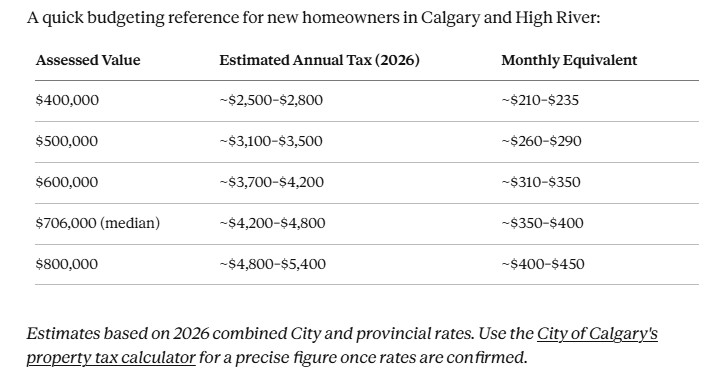
For a new home in Calgary assessed between $500,000 and $750,000 in 2026, budget approximately $3,500 to $5,200 per year in property taxes, or $290 to $430 per month. Add this to your mortgage payment, home insurance, and maintenance reserve when calculating your true monthly cost of ownership — not just your mortgage payment.
At Jenga Homes, we build new homes from $400,000 in Calgary and High River. Our fixed-price contracts mean your purchase price is locked in from day one — and our team helps you understand the full picture of monthly ownership costs before you commit, not after.
If you’d like to talk through what a new home in Calgary or High River would actually cost you per month — mortgage, taxes, insurance, and all — book a free call with our team. No pressure, no jargon.
Frequently Asked Questions
Q. How much are property taxes on a new home in Calgary in 2026?
A. For a new home in Calgary assessed between $500,000 and $750,000 in 2026, expect annual property taxes of approximately $3,100 to $5,200, or $260 to $430 per month. The City of Calgary’s median single-family home assessment in 2026 is $706,000, with a total tax bill of approximately $4,200 to $4,800. Use the City’s property tax calculator at calgary.ca for a precise estimate based on your specific assessed value.
Q. When are Calgary property taxes due in 2026?
A. Calgary property tax bills are mailed in May and are due on the last business day of June — June 30, 2026. If you enrol in the Tax Instalment Payment Plan (TIPP), you pay monthly instead of in one lump sum. TIPP is free to join and can be set up through the City of Calgary’s website. Some mortgage holders have property taxes collected and remitted by their lender — check your mortgage agreement.
Q. What percentage of Calgary property tax goes to the province?
A. In 2026, approximately 42% of your Calgary residential property tax goes to the Government of Alberta for provincial education funding. The remaining 58% stays with the City of Calgary and funds local services including police, fire, transit, roads, and parks. The provincial portion increased by 21% in 2026 — $338 more for the typical home assessed at $706,000.
Q. Can I appeal my Calgary property assessment?
A. Yes. If you believe your annual assessment is too high, you can file an appeal with the Assessment Review Board before the deadline printed on your January assessment notice (typically March). You’ll need comparable sales data from similar homes in your area. If your assessment is materially out of step with nearby sold properties, an appeal is worth pursuing and can reduce your tax bill for the year.
Q. Are Calgary property taxes higher than High River?
A. In raw dollar terms, Calgary property taxes are typically higher than High River because assessed values in Calgary are higher. Both locations pay the same provincial education portion. A new home in High River assessed at $450,000 will carry a lower total tax bill than a comparable Calgary home assessed above $700,000. For buyers comparing both markets, total monthly ownership cost — mortgage, taxes, insurance, and commute — often favours High River meaningfully.